
 EN
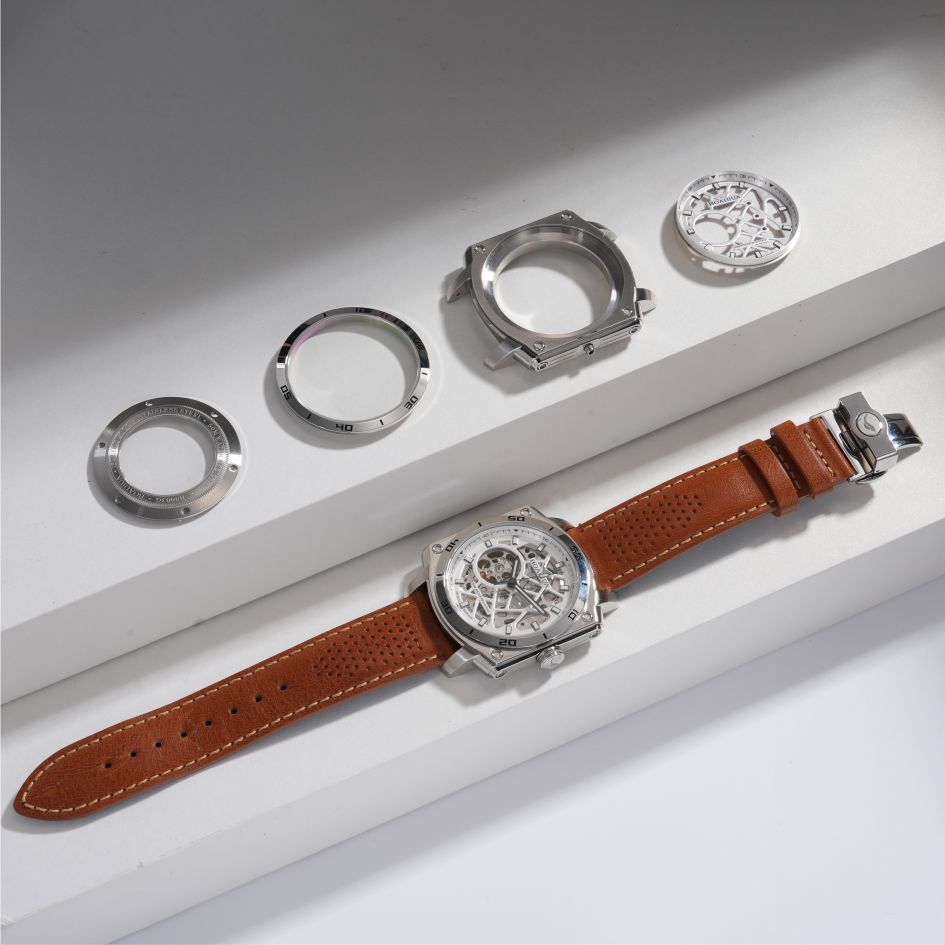
Walk into any conversation about stainless steel watch cases and the same two grades come up: 316L and 904L. The shorthand version says 904L is better because it costs more. That shorthand is not wrong, but it is not useful either. The two alloys sit in different places on the stainless steel family tree, and the difference shows up in corrosion behavior, machining response, polish character, and cost per part. A brand choosing between them is not picking a better grade. It is picking a grade that fits a specific case design and a specific wear profile.
The chemistry tells the story. 316L is a standard austenitic grade with roughly 16 to 18 percent chromium, 10 to 14 percent nickel, and 2 to 3 percent molybdenum. 904L is a super-austenitic grade with 19 to 23 percent chromium, 23 to 28 percent nickel, 4 to 5 percent molybdenum, and 1 to 2 percent copper. That extra nickel and molybdenum raise the pitting resistance equivalent number, usually called PREN, from around 24 to 26 on 316L to roughly 34 to 43 on 904L. PREN is a rough predictor of how a steel handles chlorides. A higher number suggests better resistance to pitting in salt water and sweat.
| Factor | 316L | 904L |
|---|---|---|
| Chromium | 16 to 18% | 19 to 23% |
| Nickel | 10 to 14% | 23 to 28% |
| Molybdenum | 2 to 3% | 4 to 5% |
| Copper | None | 1 to 2% |
| PREN (approx.) | 24 to 26 | 34 to 43 |
| Typical Rockwell B hardness | Often higher | Equal or lower |
| Relative raw material cost | Baseline | Roughly 2 to 4 times higher |
| Machining behavior | Predictable | Harder, more tool wear |
Corrosion Resistance Is Real, and Also Narrow
The strongest case for 904L is corrosion resistance. The higher molybdenum and the copper addition give it better resistance to chlorides and to certain acids, which is why the grade is common in chemical processing equipment. In a watch case, that translates to better performance against sweat, salt water, and repeated exposure to chlorinated water. For a dive watch or a case worn daily in humid conditions, that is a genuine benefit.
The limitation is equally real. 316L is already highly resistant to the corrosion a watch case sees in normal wear. The difference between the two grades becomes meaningful under aggressive conditions, not under ordinary ones. A wearer who takes a 316L case into the shower, the ocean, and the gym will generally not see a failure that 904L would have prevented. A wearer with a high-salt environment or a long service interval between cleanings may notice the difference at the caseback threads, where sweat and salt can accumulate. The grade choice should follow the wear profile, not the spec sheet.
Scratch Resistance Does Not Follow the Price Tag
A common assumption is that 904L scratches less because it is the premium grade. The metallurgy does not support that. The two grades have overlapping Rockwell B hardness ranges, and 904L is often equal to or slightly softer than 316L. Higher nickel and molybdenum improve corrosion resistance, not abrasion resistance. Some owners of 904L cases report hairline scratches appearing as quickly as on 316L, and the “scratches less” claim is widely repeated without a hardness basis.
That matters for a brand writing a case specification. If scratch resistance is the goal, the answer is not a higher stainless grade. It is a different surface treatment, a different alloy family, or a design that keeps polished surfaces away from high-contact areas. Choosing 904L for scratch resistance is choosing the wrong tool for the job.
The Machining Penalty Is Where the Cost Lives
The material cost of 904L is often quoted as two to four times that of 316L, but the raw material is not the larger cost driver on a machined case. The machining penalty is. 904L work-hardens more readily and generates more heat at the cutting edge. Tool wear runs higher, cycle times lengthen, and the process window narrows. A shop that runs 316L comfortably may need different tooling and different parameters to hold the same tolerance on 904L.
The tooling separation is a practical constraint that is easy to underestimate. Dies, fixtures, and cutting tools used for 316L are not automatically suitable for 904L, and a shop that switches grades mid-stream may need to re-qualify its process. That is a setup cost, not a per-piece cost, but it lands on the first batch and shapes the minimum order threshold.
A desensitized example from a case machining run: a shop moved a case design from 316L to 904L for a small batch. The first articles came off within tolerance, but thread tapping on the caseback showed higher tool wear and a slight change in thread flank finish. The thread gauge still passed, but the surface finish on the flanks was rougher than the 316L baseline. The fix was a tapping parameter change and a tool life check at shorter intervals, not a new thread design. The lesson is that 904L does not fail dramatically. It asks for more attention at the operations that were tuned for 316L.
Polishing Character Is a Design Decision
904L takes a polish that reads slightly whiter and deeper than 316L, which is one reason it is associated with a more precious look. That difference is real, but it is also subtle and lighting-dependent. A brand choosing 904L for polish character should verify it under the same lighting conditions the finished watch will be judged in, not on a sample under a single lamp.
The polishing route itself also changes. 904L work-hardens at the surface, and a polishing step that runs too hot or too fast can leave a surface that is harder to correct in a later pass. The finishing sequence has to be tuned for the grade, just like the machining sequence. A polishing spec written for 316L does not transfer to 904L without a check.
What the Choice Comes Down To
The grade decision usually reduces to three questions. First, what does the case see in service? A dress case worn indoors does not need the corrosion margin of 904L. A dive case or a case headed for a humid market may justify it. Second, what is the batch size and tooling situation? A small batch in 904L carries a setup burden that a large batch can absorb more easily. Third, what does the brand want the finish to say? 904L polishes differently, and that difference should be a deliberate part of the design, not a side effect.
Small and large batches should be held to the same quality standard regardless of grade, even though a small run carries a higher unit price because setup and tooling costs are spread across fewer pieces. That is a price gradient, not a difference in acceptance criteria.
Burriva works at the component level on dials, cases, bracelets, and buckles, with watch case production covering CNC milling, stamping, automated polishing, dimensional inspection, and multiple inspection rounds across incoming, in-process, and outgoing stages. Segregated workflows and CAD file access controls keep design files split by job role. Brands weighing 316L and 904L for a case project can contact the team to discuss case specifications, machining requirements, and inspection points.