
 EN
Why OEM Watch QC Differs from Catalog Watch Checks
A catalog watch can be checked against the factory’s own internal standard. An OEM watch cannot. Every customized part introduces a new variable: a dial printed to a specific color, a case machined to a brand’s dimensions, a bracelet finished to match a design reference. The inspection process has to account for all of those variables.
That is why OEM watch quality control starts before assembly and runs through every stage until the watches are packed for shipment. For brand owners and importers, understanding what a proper QC program looks like matters because a watch that looks good in a photo can still fail in daily use.
The Sampling Standards That Set the Rules
ISO 2859-1, equivalent to GB/T 2828.1 in China, is the foundational standard for acceptance sampling by attributes. It defines how many units to inspect from a batch based on lot size and what AQL thresholds to apply. Common AQL levels for watch inspection are Critical: 0, Major: 2.5, Minor: 4.0.
Those numbers mean something specific. An AQL of 2.5 for major defects means that for a given lot size, the sampling plan allows a certain number of major defects before the entire lot is rejected. A major defect in watch terms might be a non-functioning movement, a leaking case, or a crown that does not engage. A minor defect might be a small scratch on the caseback or a slightly misaligned date window.
For brand owners, the key is to agree on AQL levels before production starts. A factory that applies a looser standard than the brand expects will pass batches that the brand considers unacceptable.
Incoming Inspection Before Assembly
Component inspection before assembly is one of the most important QC steps. Once a watch is fully assembled, some defects become much harder and more expensive to fix.
A practical incoming inspection covers:
Watch case: dimensions, finish, plating, threads, crown tube. Common issues include scratches, poor polishing, and out-of-tolerance threads.
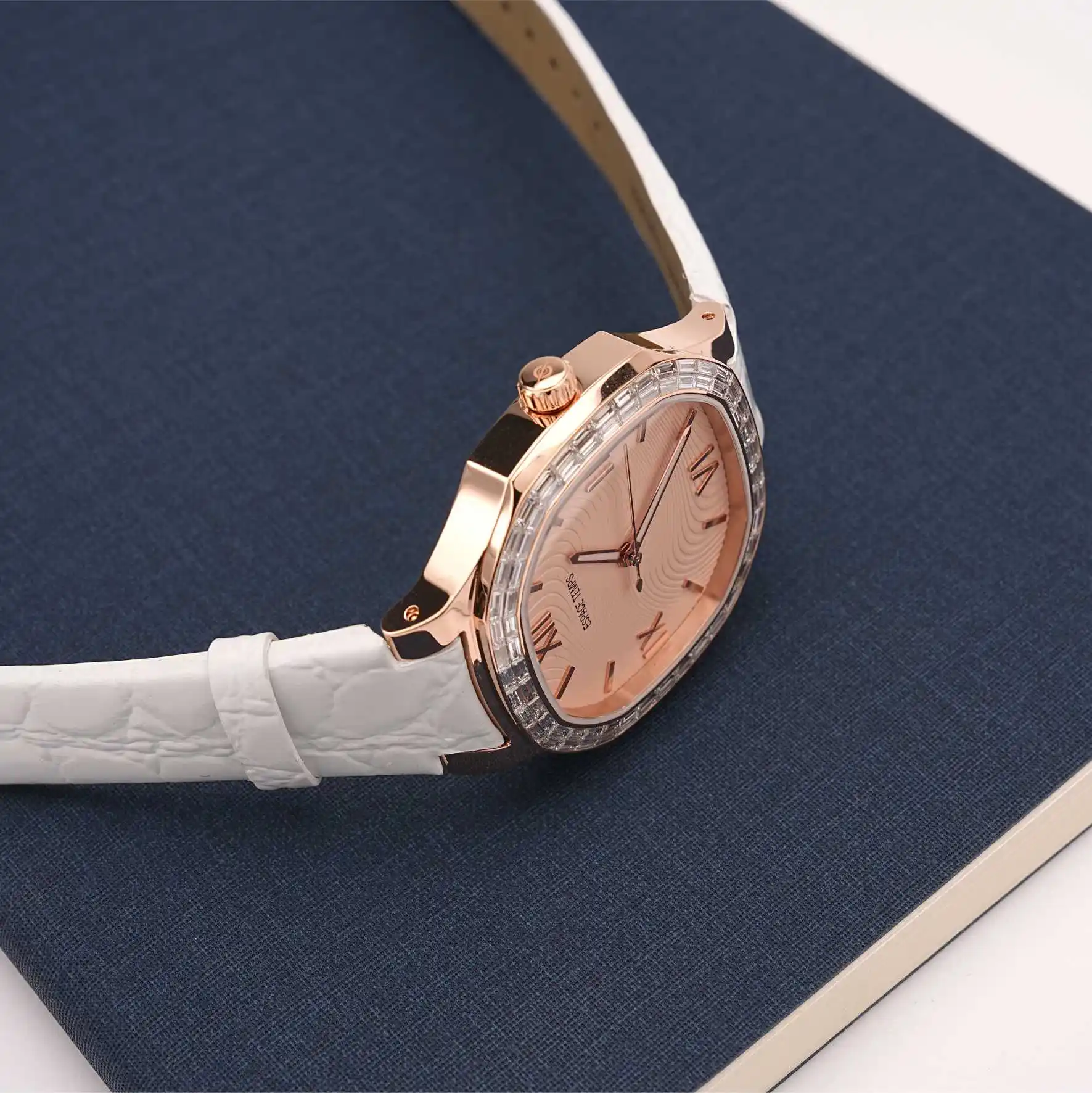
Dial: color, printing, logo, indexes, date window. Dust under the crystal, off-center logos, and color deviation from the approved standard are frequent findings.
Hands: length, color, lume application, fitting hole. Bent hands and weak lume are the usual problems.
Crystal: diameter, thickness, coating, edge quality. Chips and poor fit are the concerns here.
Movement: model, function, battery, timekeeping. In most OEM watch projects, movements are sourced components rather than factory-made parts. The factory’s job is to verify that the incoming caliber matches the approved specification and performs correctly.
Bracelet or strap: length, links, clasp, stitching, smell. Loose links and weak clasps are common.
| Inspection Stage | What to Check | Typical Findings |
|---|---|---|
| Incoming | Component dimensions and appearance | Scratches, color deviation, wrong sizes |
| In-process | Assembly fit and function | Loose hands, crown engagement issues |
| Pre-final | Water resistance, timing | Leaks, out-of-spec rate deviation |
| Final | Cosmetic and packaging | Dust under crystal, logo alignment, box damage |
Water Resistance Testing and What It Really Proves
Water resistance is one of those specifications that can pass a sample test and still fail in production. The issue is often the gasket, not the case itself. A gasket that is slightly out of tolerance or improperly seated can create a leak path that only shows up under pressure.
A proper water resistance test involves both air testing and water immersion. Air testing is faster and catches gross leaks. Water immersion under controlled pressure verifies the actual rating. Some factories run a quick air test on every unit and then batch-test water immersion on a sample basis. That approach is fine for standard models, but for a new case design with a new gasket, 100% water testing for the first production run is a reasonable requirement.
Timing, Movement, and Functional Checks
Timing checks fall into two categories: rate deviation and amplitude. Rate deviation is how fast or slow the watch runs per day. Amplitude is a measure of the movement’s health, specifically how far the balance wheel swings. A movement with low amplitude may still keep decent time when new but will degrade faster over time.
For quartz movements, the relevant checks are battery voltage under load and the accuracy of the stepping motor. A quartz movement that draws excessive current will have a shortened battery life even if it functions correctly at the time of inspection.
Functional checks should also cover crown operation, date change, bezel rotation if applicable, and bracelet clasp engagement. These are the points a customer touches every day, and they deserve the same attention as cosmetic inspection.
A Batch Color Issue from the Floor
During a pre-shipment inspection for a brand’s first order with a new factory, the QC team found that roughly 8% of units had a slight but noticeable difference in dial color compared to the approved sample. The supplier’s explanation was that the dials came from two production batches with slightly different lacquer lots. The supplier had not flagged the issue because both batches individually matched the color standard within what the factory considered acceptable tolerance.
The brand’s response was to require that all dials for a single order be produced from the same lacquer lot, with a pre-production color approval step. The added cost was minimal. The potential cost of a batch that customers notice as inconsistent was much higher.
That experience highlights a recurring theme: QC standards need to be defined in terms that account for batch-to-batch variation, not just individual unit conformity.
Where BURRIVA Fits
BURRIVA, short for Baoruihua (Dongguan) Precision Technology Co., Ltd., has been manufacturing precision watch components since 2006, with a facility in Dongguan covering over 20,000 square meters. The company’s quality framework includes incoming material inspection, in-process checks, and final shipment testing across its dial, case and bracelet production lines. For brand owners who need a manufacturing partner with an established QC protocol, BURRIVA’s production infrastructure and documentation practices provide a working foundation.