
 EN
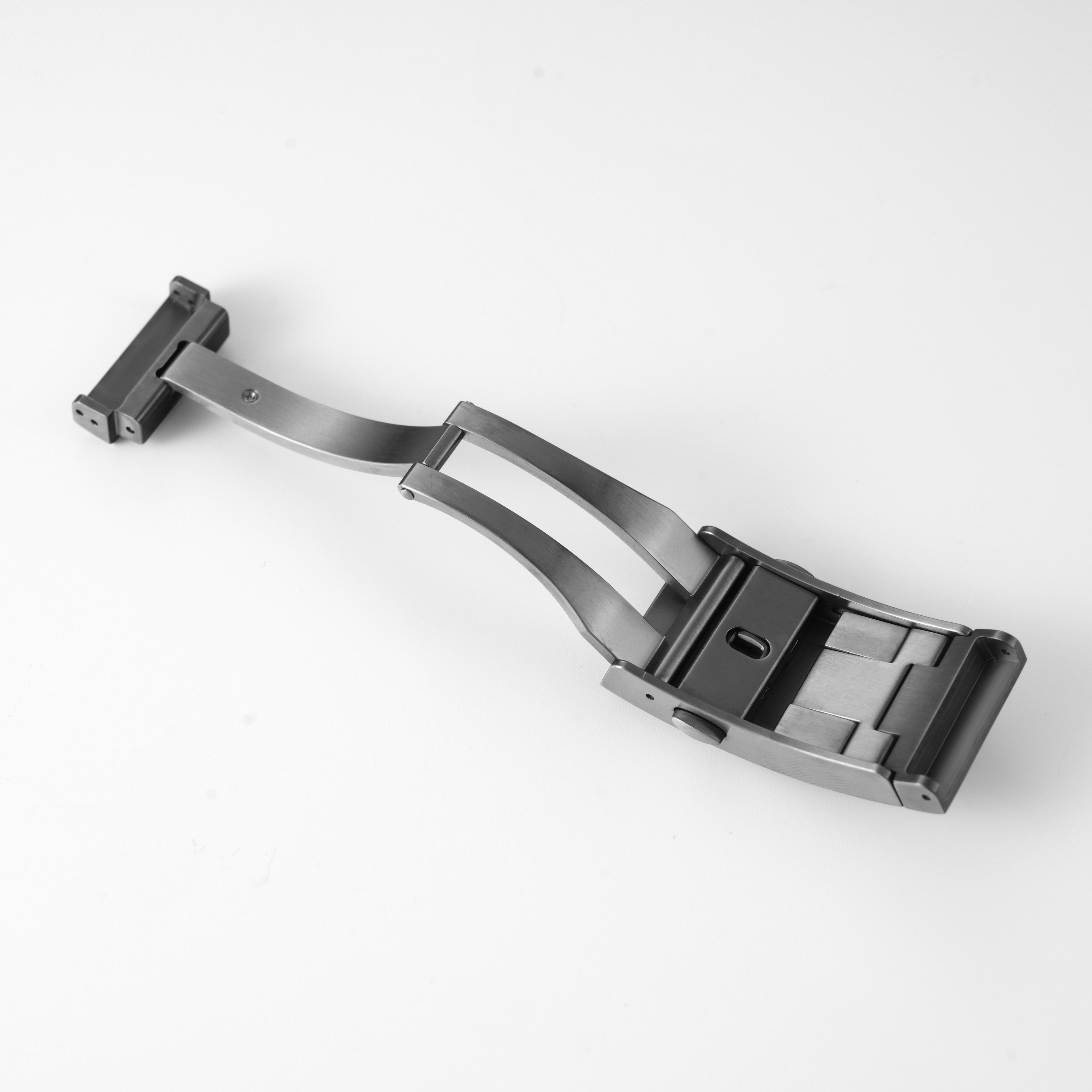
Buyers often pick a buckle the way they pick a color: by look. That approach causes problems later. A buckle that works well on a leather strap can be a poor match for a metal bracelet. A buckle that feels fine on a fabric NATO can be awkward on a thick rubber strap.
The strap type sets the constraints. Thickness, flexibility, stretch behavior, and how the strap wears at the fold point all shape what the buckle needs to do. A buckle that ignores those constraints will fit at first and create problems over time, usually at the fold point or the attachment point.
Choosing a buckle starts with the strap, not the buckle catalog.
Leather Straps: Where the Fold Point Decides
Leather is the most common strap material, and it is also the one where buckle choice affects strap life the most.
A tang buckle is the traditional match for leather. It relies on hole-and-pin adjustment, which works well on leather because the material holds its shape and the holes stay clean. The limitation is that repeated bending at the same point eventually creates a crease, and the crease becomes a crack.
A deployant clasp solves that problem by letting the strap keep its shape. Instead of bending at one point, the strap folds along a longer curve inside the clasp. That extends leather life considerably, which is why deployant clasps are common on higher-end leather straps.
A butterfly buckle sits between the two. It offers a lower profile than a deployant but a narrower adjustment range. It suits leather straps that do not need frequent fine tuning.
| Strap type | Common buckle match | Main reason |
|---|---|---|
| Leather | Tang or deployant | Deployant reduces fold-point wear |
| Metal bracelet | Butterfly or deployant | Needs secure lock and clean lines |
| Rubber or silicone | Tang or deployant | Deployant handles thick material better |
| Fabric or NATO | Tang | Simple, secure, easy to replace |
| Mesh | Deployant or butterfly | Flat profile matches mesh construction |
Metal Bracelets: Security and Line Matter Most
On a metal bracelet, the buckle is part of the visual design, not just a fastener. A bulky buckle breaks the bracelet line. A poorly matched buckle creates an odd angle where the bracelet meets the wrist.
Butterfly buckles are the common choice for metal bracelets because they fold flat and keep the bracelet line clean. The low profile sits well against the wrist and avoids the bulky hardware look that deployant clasps can create.
Push-button release adds a security layer. Two buttons must be pressed at the same time, which lowers the risk of accidental release. The trade-off is that button mechanism tolerances matter more. Loose buttons or weak spring preload show up as play in the locked position.
Deployant clasps also work on metal bracelets, especially when fine adjustment is important. The internal slider or push-pin system lets the wearer tune the fit without removing links.
Rubber and Silicone: Handling Thickness and Stretch
Rubber and silicone straps present a different problem. They are thicker than leather, they stretch slightly under load, and they do not hold a crease the way leather does.
A tang buckle works, but the pin has to be long enough to pass through the strap and the holes need to be reinforced. Rubber can tear at the hole edges over time if the strap is thin or the pin is sharp.
A deployant clasp often suits rubber better because it distributes the load over a longer section of the strap. The strap does not need to bend at a single point, which reduces stress at the hole area. The trade-off is that the clasp has to accommodate the strap thickness without pinching or leaving a gap.
Silicone behaves similarly, though it tends to be softer. A buckle that grips too tightly can leave permanent marks on silicone. That is a specification issue, not a defect.
Fabric and NATO: Simplicity Wins
Fabric straps, including NATO and single-pass designs, work best with a tang buckle. The strap passes through the buckle frame, the pin goes through a hole, and a keeper holds the tail. The system is simple, replaceable, and secure.
Deployant clasps are less common on fabric because the material does not hold shape well inside the folding mechanism. The clasp can pinch the fabric or leave a visible crease. Butterfly buckles have the same problem.
For field watches, dive watches, and any application where quick replacement or cleaning matters, the tang buckle is the practical choice. It is also the easiest to service in the field, which matters for straps that see heavy use.
A Field Case Where Buckle and Strap Did Not Match
A brand launched a leather strap with a butterfly buckle. The sample looked good, and production began. A few weeks later, returns started arriving with a consistent comment: the leather was cracking at the fold point near the clasp.
The investigation found that the leather thickness and the butterfly clasp geometry were not matched. The clasp forced the leather to bend at a tighter radius than the material could handle repeatedly. The buckle was within specification, and the leather was within specification, but the combination was not validated together.
The fix required switching to a deployant clasp with a larger fold radius and adding a flex test on the assembled strap and buckle before production. The buckle specification changed. The leather did not.
That pattern repeats across strap and buckle projects. Each part can pass on its own while the assembly fails. Testing the assembly as a unit is what catches the mismatch.
What to Confirm Before Matching Buckle to Strap
A few items belong in the specification before tooling starts.
Strap thickness and flexibility at the fold point.
Buckle type and the adjustment range it provides.
Attachment method and how it interacts with the strap material.
Functional test on the assembled strap and buckle.
Surface finish on contact areas that touch the strap.
Inspection criteria for buckle function and strap fit.
Buckle and strap matching depends on how well thickness, fold behavior, attachment, and functional testing are defined before tooling. Burriva, short for Baoruihua (Dongguan) Precision Technology Co., Ltd., focuses on OEM watch components from its Dongguan production base, with in-house capabilities across dials, cases, bracelets, and buckles. Buckle production combines CNC milling, stamping, automated polishing, dimensional inspection, and functional checks on assembled clasps. To discuss buckle specifications, strap compatibility, and approval criteria, get in touch with Burriva.