
 EN
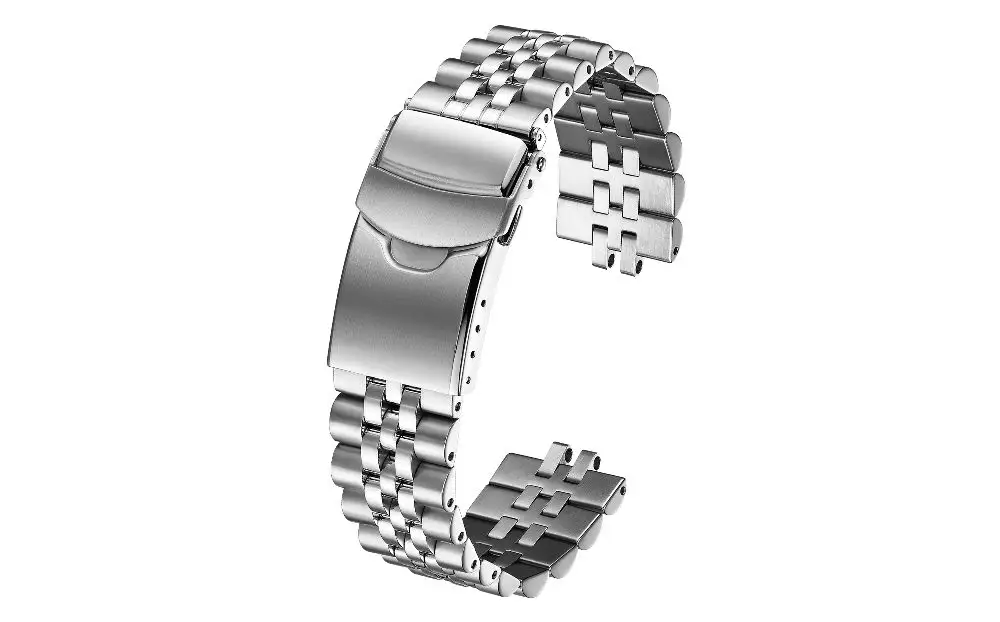
Why Bracelet Quality Is Judged by Hand, Not by Photo
A bracelet photo shows shape and finish. It cannot show how the links move, how the clasp sounds, or how the bracelet sits after an hour on the wrist. Premium bracelet quality lives in those details, and buyers who have worn enough watches learn to judge a bracelet within seconds of handling it.
The signals are consistent. A well-made bracelet articulates smoothly without rattle. The clasp closes with a clear click. The links align when the bracelet drapes. None of these show up in a spec sheet, but all of them trace back to how the bracelet was specified, tooled, and inspected.
Link Fit and Articulation Are the First Test
Link fit is the foundation. When tolerances between pin and hole are right, the bracelet drapes smoothly and feels solid in the hand. When they are too loose, the bracelet rattles and twists. When they are too tight, links bind and wear against each other.
A useful check is to hold the bracelet by one end and let it hang. A well-made bracelet falls into a smooth curve. Links that stick or flop unevenly point to inconsistent tolerances. Shaking it gently should produce no metallic rattle.
This is where tolerance stack-up matters. Individual links can pass inspection while the assembled bracelet fails, because the clearance accumulates across dozens of joints. The reliable way to catch this is to test the assembly as a unit, not just the parts.
Surface Finish Consistency Across the Whole Assembly
A premium bracelet maintains its finish across every link, every edge, and every transition. Inconsistency shows up in a few ways.
Uneven brushing. The grain direction should run the same way across adjacent links, with no change in depth or angle at the edges.
Mixed finish boundaries. Where polished and brushed areas meet, the boundary should be crisp and consistent, not wandering.
Color drift. On coated bracelets, batch-to-batch color variation is one of the first signs of process drift.
Edge quality. Sharp edges on the underside of links are a common complaint. A premium bracelet has consistent chamfers and no burrs.
Finish is labor-intensive, which is why it often gets compressed during production. That compression shows up as inconsistency, and inconsistency reads as lower quality to anyone handling the bracelet.
| Quality Indicator | What to Check | Common Failure |
|---|---|---|
| Link fit | Articulation and rattle | Loose or binding joints |
| Surface finish | Grain direction and edges | Uneven brushing, sharp edges |
| Clasp function | Open-close feel and sound | Slack buttons, weak lock |
| Dimensional consistency | Link interchangeability | Batch-to-batch variation |
| Weight distribution | Balance on the wrist | Heavy head, light tail |
Clasp Function and Feel
The clasp is the part most people interact with, and its feel is one of the clearest quality signals.
A premium clasp opens with predictable force and closes with a defined click. It has no play when locked. The buttons, if present, travel smoothly and return to position without sticking. The clasp body aligns with the bracelet line rather than sitting at an odd angle.
Clasp quality depends on assembled function, not just part dimensions. A clasp built from parts that each sit within tolerance can still feel loose if the combined clearance drifts beyond what the sample showed. That is why functional checks on assembled clasps belong in the inspection plan.
Material and Weight Distribution
Material grade affects durability, but weight distribution affects how the bracelet feels on the wrist.
A bracelet that is heavy at the clasp end and light near the lugs will feel unbalanced, and that imbalance shows up as the watch rotating on the wrist. A well-designed bracelet distributes weight evenly, so the watch stays in place without constant adjustment.
Material choice also shapes the finish and wear characteristics. Stainless steel offers predictable finishing and good corrosion resistance. Titanium reduces weight but is harder to machine and finish consistently. Each material brings its own process requirements, and a supplier without experience in a given material will show it in the finish consistency.
Dimensional Consistency Across Batches
A premium bracelet holds its dimensions across production runs, not just in the first sample. This matters for two reasons.
First, a replacement link ordered a year later should fit the same bracelet without modification. Second, batch-to-batch consistency affects how the bracelet ages. If the first batch has tighter tolerances than the second, wearers will notice the difference over time.
CMM checks against the approved drawing catch this. Regular in-process measurement during long production runs catches it earlier. Without measurement, drift goes unnoticed until the assembled bracelet shows it.
A Field Case Where Finish Consistency Drove Returns
A brand launched a bracelet with a brushed finish across the link faces and polished bevels on the edges. The sample was approved. Production began, and the first batches passed pre-shipment checks.
Within a few months, returns began arriving with a consistent comment: the brushed surface on some links looked different from others. The investigation found that the brushing process had been performed on two different stations with slightly different abrasive specifications. Each station's output passed inspection individually, but the two batches did not match each other under retail lighting.
The fix required consolidating the brushing process onto a single station, adding a surface roughness check to the inspection plan, and running a side-by-side visual comparison against the approved sample before each batch shipped.
The case was not a manufacturing failure. It was an inspection gap. The specification defined the finish, but nothing verified it batch to batch.
What to Confirm Before Approving a Bracelet
A few items belong in the approval checklist before mass production begins.
Assembled bracelet articulation test, not just individual link checks.
Surface roughness specification for brushed and polished areas.
Clasp functional test on assembled units.
Color and finish comparison against the approved sample under consistent lighting.
Dimensional checks against the approved drawing at defined intervals.
These checks add time to the sample stage. They save far more time in the production stage, where correcting a finish or fit problem is much more expensive.
Bracelet quality depends on how well link tolerances, surface finish, clasp function, and batch consistency are specified and verified. Burriva, short for Baoruihua (Dongguan) Precision Technology Co., Ltd., focuses on OEM watch components from its Dongguan production base, with in-house capabilities across dials, cases, bracelets, and buckles. Bracelet production combines CNC milling, stamping, automated polishing, dimensional inspection, and functional checks on assembled bracelets. To discuss bracelet specifications, finish requirements, and approval criteria, get in touch with Burriva.
Table of Contents
- Why Bracelet Quality Is Judged by Hand, Not by Photo
- Link Fit and Articulation Are the First Test
- Surface Finish Consistency Across the Whole Assembly
- Clasp Function and Feel
- Material and Weight Distribution
- Dimensional Consistency Across Batches
- A Field Case Where Finish Consistency Drove Returns
- What to Confirm Before Approving a Bracelet