
 EN
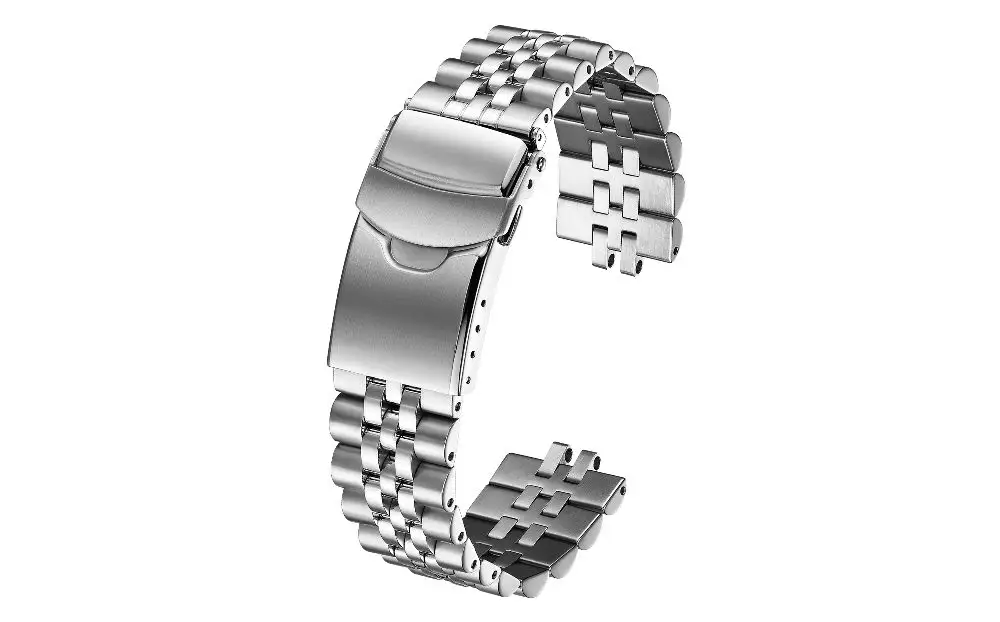
A watch brand can spend months refining a dial and still ship a product that feels cheap because the bracelet rattles, pinches, or loses its finish within weeks. Stainless steel bracelets carry most of the tactile experience. Weight on the wrist, smoothness of each link edge, and clasp alignment all come from manufacturing decisions made long before assembly.
Brands that outsource production need to understand how these parts are made, because the difference between a solid bracelet and a hollow one is not visible in a catalog photo. Steel selection and inspection routines determine whether the final product holds up to daily wear.
Starting With the Right Steel Grade
Not all stainless steel behaves the same way on a wrist or on a production line. Grade 304 offers decent corrosion resistance and machines easily, which keeps costs down. Grade 316L adds molybdenum, improving resistance to chlorides and sweat, and it remains the common choice for mid-range and premium bracelets. Grade 904L goes further with higher nickel and molybdenum content, offering better corrosion resistance in harsh environments, but it is harder to machine and significantly more expensive.
Matching the steel grade to the intended market and wearing conditions matters more than choosing the most expensive option.
| Property | 304 | 316L | 904L |
|---|---|---|---|
| Corrosion resistance | Good | Better | Best |
| Machining difficulty | Low | Medium | High |
| Typical cost level | Lower | Moderate | Higher |
| Common use | Entry level | Mid to high end | Luxury |
| Weldability | Good | Good | Moderate |
Forming and Cutting Link Components
Link production begins with flat steel strips or solid bars, depending on the design. Stamped links are punched from sheet metal using progressive dies, which is fast and cost effective for high volumes. Solid links are milled from blocks or bars with CNC machines, producing a heavier feel and tighter tolerances.
Both methods require precise tooling, because a difference of a few hundredths of a millimeter can cause links to bind or rattle. After cutting, each link goes through deburring to remove sharp edges. Tumbling, vibratory finishing, or brushing may be used. Then the links are bent, folded, or welded into their final shape. For multi-link designs such as three-piece or five-piece bracelets, the center links and outer links are formed separately and later joined.
Assembly, Pins, and Clasp Integration
Assembly is where small errors become obvious. Pins, screws, or friction-fit tubes connect the links, and each connection must allow smooth movement without excessive play. Screw-in pins offer better serviceability, while friction pins reduce cost and weight.
The clasp often receives less attention than it deserves. A folding clasp with a safety latch adds security, but poor spring tension or a misaligned release button can ruin the wearing experience. Water resistance is not usually a bracelet specification, but the clasp and end links still need to shed moisture and resist rust. Gaps that trap moisture can lead to staining or corrosion over time.
Bracelet Finishing Techniques That Define the Feel
Bracelet finishing transforms a functional assembly into a product that looks and feels premium. Polishing creates a mirror surface, while brushing produces satin lines that hide scratches better. Sandblasting gives a matte texture. Many bracelets combine two or three finishes on different surfaces to create contrast.
The challenge is keeping the boundaries sharp, because polish bleeding into a brushed area looks sloppy. Electroplating and PVD coatings add color and extra wear resistance. PVD, or physical vapor deposition, is generally harder than electroplating and less likely to flake. Neither process is indestructible. Deep scratches can still expose the base steel.
Quality Checks That Catch Problems Early
Quality control for bracelets focuses on dimensions, function, and surface appearance. Inspectors check link width, thickness, pin hole alignment, clasp operation, and finish consistency. Salt spray testing per ISO 9227 or ASTM B117 can reveal corrosion weaknesses before shipment. Sampling often follows ISO 2859-1, with acceptance limits set according to the brand's tolerance for defects.
A useful example comes from a bracelet production run in southern China. A batch of 316L links passed visual inspection but showed pitting after salt spray testing. The root cause was not the steel itself. Residual iron particles from an upstream stamping tool had not been fully removed during cleaning. The particles created tiny galvanic sites that accelerated corrosion.
Adjusting the cleaning bath and adding a passivation step solved the problem, but only because the factory tested before shipping.
Matching Manufacturing Choices to Brand Positioning
Bracelet manufacturing involves trade-offs. Stamped links keep costs down but feel lighter. Solid links add heft and durability but require more machining time. 904L offers superior corrosion resistance but raises the price and limits the number of factories willing to work with it. A brand targeting everyday wear in humid climates may get more value from 316L with a good PVD coating than from 904L with a basic polish.
None of these choices is automatically better. The right combination depends on the target market, the price point, and how the bracelet will be worn. A brand that understands these trade-offs can specify the bracelet with intent rather than accept whatever the supplier proposes.
Bracelet outcomes depend on how well steel grade, link forming, assembly tolerances, finishing, and inspection are matched from the first drawing to the final carton. Burriva, short for Baoruihua (Dongguan) Precision Technology Co., Ltd., focuses on OEM watch components from its Dongguan production base, with in-house capabilities across dials, cases, bracelets, and buckles. Bracelet production combines CNC milling, stamping, automated polishing, and dimensional inspection, with functional checks on assembled bracelets. To discuss bracelet specifications, material options, or approval criteria, get in touch with Burriva.