
 EN
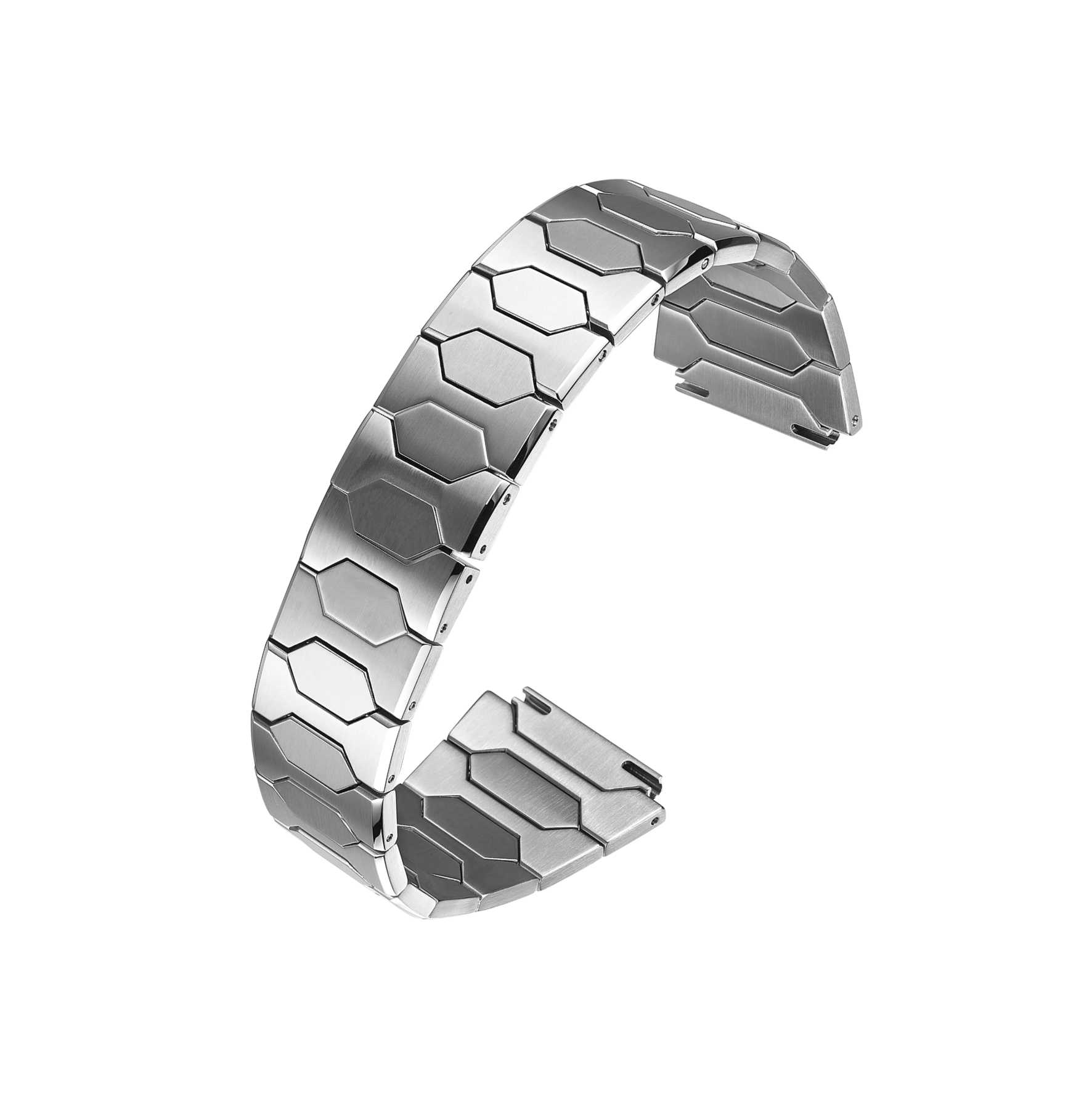
A bracelet quote rarely comes down to a single number. The price difference between two suppliers usually traces back to material grade, machining difficulty, surface treatment, and link design. Two bracelets that look identical on a drawing can land far apart on price once the material changes.
Stainless steel is the common starting point. It is available, machines predictably, and takes surface treatment well. Once a supplier moves from 304 to 316L, or from stainless steel to titanium, the cost structure shifts. The shift is not only about raw material price. It is also about tool wear, cycle time, scrap rate, and finishing effort.
That is why material decisions belong in the early specification conversation, not in a late cost-cutting round. By the time tooling is cut, changing the base material means re-validating every downstream step.
Stainless Steel: Not All Grades Are Equal
Stainless steel is not one material. 304 and 316L are the two most common grades in bracelet work. 304 costs less and performs adequately in normal conditions. 316L contains molybdenum, which improves corrosion resistance and holds up better in salt-spray testing and against sweat exposure.
For most watch bracelets, 316L is the practical standard. It machines predictably, polishes and brushes consistently, and holds up well across production batches. That is why its higher price usually comes with a lower rejection rate, which can offset part of the material cost difference.
Cost differences inside stainless steel come from several places. The grade itself, the complexity of the link design, the surface finish requirement, and the production method all play a role. A mirror-polished surface takes more labor than a brushed one. A multi-piece link assembly with tight tolerances takes more machining time than a simple flat link.
Titanium and Alternative Materials: Higher Cost, Different Trade-offs
Titanium bracelets sit lighter on the wrist and are hypoallergenic, which makes them attractive for certain brand positions. Titanium is harder to machine. Its low thermal conductivity wears cutting tools faster, and heat management during machining is more demanding. CNC parameters need careful control, and cycle times are often longer. Raw titanium also costs more than stainless steel.
Ceramic links offer a distinct look and scratch resistance, but the material is brittle. It can chip during assembly or after impact, which raises handling and rejection risk. Carbon fiber is light and visually distinctive, but its structural behavior differs from metal, so link design and pin engagement need to be rethought. Copper alloys and aluminum are easier to machine but offer weaker corrosion resistance, which limits where they make sense.
None of these materials is automatically better. The right choice depends on the design intent, the target price, and how the bracelet will be worn.
| Material or process | Relative cost | Main strength | Main limitation |
|---|---|---|---|
| 304 stainless steel | Lower | Easy to machine, low cost | Moderate corrosion resistance |
| 316L stainless steel | Moderate | Corrosion resistance, stable finishing | Slightly higher cost |
| Titanium | Higher | Light, hypoallergenic | Harder to machine, tool wear |
| Ceramic | Higher | Distinct look, scratch resistance | Brittle, assembly risk |
| PVD coating | Moderate | Color options, surface hardness | Adhesion depends on pre-treatment |
| CNC machining | Moderate to high | Precision, complex shapes | Higher unit cost, slower per part |
How Manufacturing Methods Change the Cost Equation
Stamping suits high-volume production. The die costs more upfront, but the per-unit cost drops as volume rises. A progressive die can form, cut, and punch links in a continuous sequence, which keeps cycle time low. The trade-off is that the die wears over time, and dimensional drift has to be monitored.
CNC machining offers more flexibility. It handles complex link geometry without dedicated tooling and holds tight tolerances well. The downside is speed and cost. CNC is slower per part and more expensive at high volumes. It makes the most sense for low-to-mid volume runs, complex shapes, or parts that need tight tolerances.
The two methods are not mutually exclusive. Many bracelet projects use stamping for flat links and CNC for complex or low-volume components. The cost equation depends on how those methods are combined and how well each step is controlled.
A Field Case Where Material Choice Forced Rework
A brand selected a lower-cost copper alloy for a bracelet batch. The samples passed appearance checks, and production began. After the first shipments, wearers reported discoloration and peeling along the edges after sweat exposure. The surface treatment had not bonded well to the substrate.
The investigation found that the problem was not the finishing process alone. It was the combination of the alloy and the chosen coating, which had not been validated together under real wear conditions. The brand switched to 316L stainless steel and revised the surface treatment, and the issue disappeared.
The lesson was straightforward. Material and coating have to be tested as a system, not separately. A coating that performs well on one substrate may behave differently on another, and the difference usually shows up after the product is in the field.
What Actually Drives Durability
Durability is not just about the base material. Link fit tolerances, pin hardness, surface finish quality, and assembled function all shape how long a bracelet holds up. A bracelet made from good material but with loose tolerances can develop rattle and uneven wear earlier than a bracelet made from a more modest material with stable process control.
Match material grade to expected wear conditions, not just to appearance.
Confirm surface treatment adhesion on the actual substrate.
Set tolerance windows that account for worst-case link combinations.
Test assembled bracelets for articulation and play, not just individual links.
Check pin hardness and hole geometry against the approved sample.
Material decisions always involve a trade-off between cost, machinability, and long-term wear. Burriva, short for Baoruihua (Dongguan) Precision Technology Co., Ltd., works on OEM watch components from its Dongguan base, with bracelet production that covers CNC milling, stamping, automated polishing, and dimensional inspection. Brands weighing material options for a bracelet program can reach out to discuss grade selection, finish requirements, and how different choices affect pricing and durability.