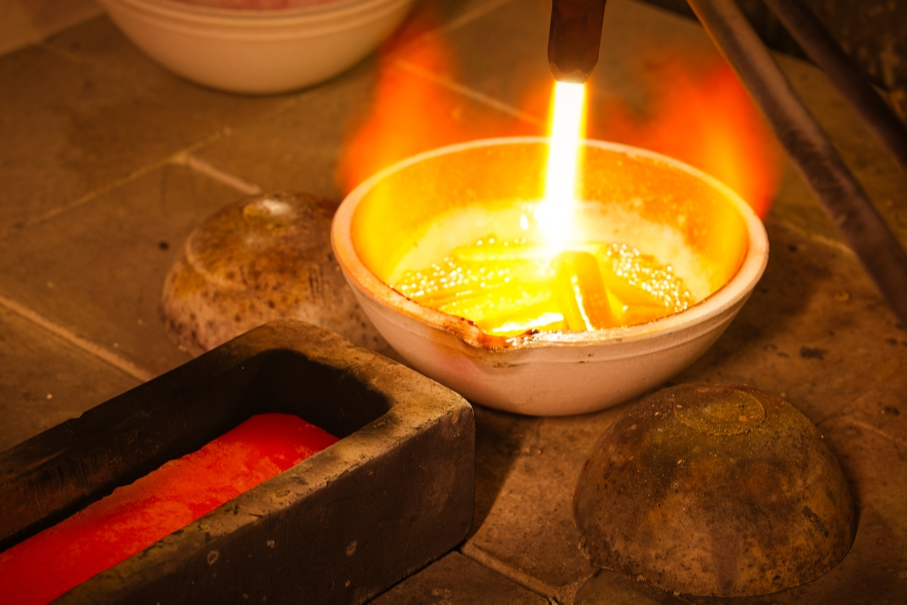
Gold watch manufacturing operates at the convergence of material science, artisanal craftsmanship, and raw materials economics. The price of gold reached record levels in 2026, with spot prices trading just under $4,500 per ounce—approximately 70% above January 2025 levels. By mid-2026, prices remained elevated around $4,300 per ounce, nearly double the $2,000 per ounce level recorded in 2024.
These figures carry direct production implications. A Rolex 18K gold watch contains approximately 75% pure gold by weight. At 2024 prices, the raw gold content represented roughly $14,000 of the watch's material cost. At 2026 prices, that same gold content costs approximately double. This price volatility has fundamentally altered how brands approach precious metal sourcing, inventory management, and pricing strategy.
Gold watch bracelets and cases are produced in three distinct material categories, each with different manufacturing processes, cost structures, and durability profiles.
18K Solid Gold designates an alloy containing 75% pure gold, with the remaining 25% composed of copper, silver, palladium, or zinc to improve hardness and scratch resistance. Solid gold components are cast, forged, or machined from solid precious metal stock. They can be resized, repaired, and polished repeatedly over decades without wearing through a surface layer. The trade-offs are cost and weight—gold's density of approximately 19 g/cm³ makes solid gold bracelets substantially heavier than steel or titanium alternatives.
Gold Alloy refers to base metals combined with gold at lower karat ratings—typically 9K, 10K, or 14K. Gold content ranges from 37.5% to 58.5%. These alloys occupy the middle ground between solid gold and plated options. They are more affordable than 18K while retaining gold content throughout the material thickness, meaning scratches do not expose a different-colored substrate.
Gold-Plated involves a thin layer of gold electroplated onto a base metal substrate—commonly stainless steel or brass. Under ISO 3160-2:2015 (Watch cases and accessories — Gold alloy coverings — Part 2: Determination of fineness and thickness), a watch is legally considered gold-plated only when the gold coating measures at least 5 microns in thickness. High-end plated bracelets often specify coatings of 7 to 20 microns. Coatings thinner than 5 microns are typically labeled "gold-toned" rather than gold-plated.
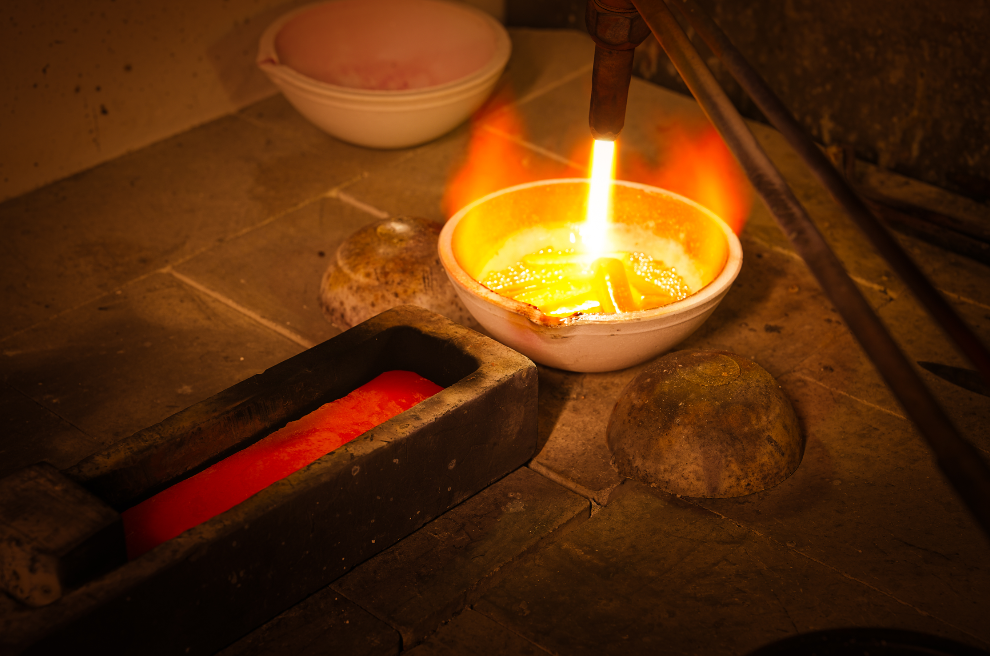
Gold watch component production follows a sequence that begins with raw material preparation. Gold is melted in graphite crucibles at temperatures exceeding 1,150°C. The molten metal is filtered to remove impurities and cast into ingots or rolled into sheets of precise thickness.
Case and bracelet production diverges from this point. Cases are typically formed through die-striking—a high-pressure forging process that produces near-net shapes with optimal grain structure—followed by CNC machining for precise dimensions and feature details. Bracelet links may be stamped from sheet material or cast, then finished through progressive polishing, brushing, and surface treatment stages.
The finishing phase is where the material cost meets labor intensity. A solid gold case may require twelve or more polishing stages to achieve the desired mirror finish. Each stage removes a controlled amount of material, which is why initial casting allowances must account for finishing losses. This material loss represents a direct cost—gold removed during polishing cannot be recovered with full value.
A U.S.-based watch brand evaluated gold bracelet suppliers for a limited edition collection in 2025, requiring 500 units of an 18K solid gold bracelet. The evaluation process revealed significant variation in supplier quoting methodologies.
One supplier quoted based on the finished weight of the bracelet. A second quoted based on the raw gold weight plus a separate fabrication fee. A third offered an all-in price that bundled material and fabrication without line-item separation. The brand selected the supplier offering transparent gold pricing linked to the daily spot market—meaning the brand paid a fair market price for the gold content plus a transparent fabrication fee.
The selected supplier also provided daily metal reconciliation reports, documenting the gold weight consumed, weight lost to finishing, and scrap recovery. This level of transparency has become a competitive differentiator in the precious metal supply chain, as it protects brands from opaque markups and enables accurate cost forecasting across fluctuating gold prices.
Evaluating a gold watch manufacturer requires assessment across four verifiable dimensions:
Evaluation Criteria |
What to Verify |
Red Flags |
Gold Sourcing Transparency |
Daily spot price linkage, separate material/fabrication cost line items, daily metal reconciliation reports |
All-in pricing without breakdown, refusal to separate material cost from fabrication |
Karat Consistency & Alloy Control |
Independent assay testing, documented alloy recipes, color reference standards across batches |
No third-party assay verification, visible color variation between production batches |
Finishing Capability & Yield Control |
Sample cases with complex geometries, documented finishing rejection rates, recovery protocols for polishing dust |
Limited finish options, rough transitions between brushed and polished surfaces |
Production Scalability |
Clear capacity numbers, documented lead times, reference clients with similar order volumes |
Vague capacity statements, inconsistent delivery history |
The most capable precious metal manufacturers maintain in-house assay laboratories and can provide independent certification of gold content per batch. They also work with established precious metal refiners who supply consistent alloy formulations and provide traceability documentation from refinery to finished component.
Gold watch manufacturing is becoming increasingly specialized. The same suppliers who dominated the mid-market a decade ago now face competition from specialists focused exclusively on precious metal work. These specialists invest in dedicated infrastructure—vacuum casting machines to minimize oxidation, precision rolling mills for consistent sheet thickness, and specialized polishing lines with dust recovery systems that capture gold particulates.
For brands, this specialization offers better options but requires more rigorous selection. The lowest bidder rarely delivers the quality required for precious metal work. The highest-priced supplier is not always the best fit either. The optimal selection is a supplier with documented precious metal expertise, transparent gold pricing, and a track record of consistent delivery across multiple production cycles.
Q: How can a brand verify the karat content of a delivered gold bracelet?
A: Independent assay testing is the only reliable method. Brands should reserve samples from each production batch and submit them to a third-party assay laboratory. Manufacturers with in-house XRF spectrometers can provide preliminary readings, but third-party verification provides the legal and commercial protection necessary for precious metal products.
Q: What is the practical lifespan difference between 18K solid gold and gold-plated bracelets?
A: An 18K solid gold bracelet can last multiple generations with regular polishing—the material thickness is the same throughout. A gold-plated bracelet with 5-micron coating will typically show visible wear-through at friction points—clasp surfaces, inner link contacts—within 3 to 5 years of daily wear. A 20-micron coating extends this to 8 to 10 years, but eventual substrate exposure is inevitable.
Q: Does gold alloy composition affect the machining difficulty?
A: Yes, significantly. Higher gold content (18K) produces softer, more ductile alloys that are easier to polish but more prone to galling and smearing during CNC operations. Lower karat alloys (9K–14K) are harder and machine more predictably but require different tool coatings and cutting parameters to avoid excessive tool wear. Manufacturers must document their specific alloy formulations and demonstrate calibrated machining programs for each variant.

Baoruihua (Dongguan) Precision Technology Co., Ltd. is a precision watch manufacturer specializing in OEM and ODM watch components, including cases, dials, bracelets, and buckles. We provide stable production, strict quality control, and reliable supply for global watch brands. Contact us to discuss your project.
Building5, No.459 Xiecao Road, Xiegang town, Dongguan, Guangdong
Copyright © 2025 by Baoruihua (Dongguan) Precision Technology Co., Ltd. Privacy Policy
 EN
EN
 Hot News