For nearly two decades, the global watch industry operated on a sourcing model that prioritized cost fragmentation over structural coherence. Brands sourced movements from Switzerland, cases from Southern China, dials from Germany, hands from France, and straps from Italy—assembling the final product in a sixth location. This geographic dispersion worked when volumes were high and margins were sufficiently thick to absorb the logistical friction and communication overhead.
2026 presents a fundamentally different operating environment. According to the Federation of the Swiss Watch Industry (FH) 2025 annual report, Swiss watch exports declined 1.7% in value to 24.4 billion francs, with volume dropping 4.8% to 14.6 million units. Simultaneously, China's clock and watch manufacturing market expanded to $5.4 billion, registering 2.5% year-over-year growth. These divergent trajectories indicate a structural realignment, not a cyclical fluctuation.
The conventional multi-vendor model imposes three persistent operational deficits that compound across production cycles.
First, lead-time unpredictability scales with supplier count. A delay at any node—a movement shipment held at customs, a case supplier's CNC machine downtime—propagates through the entire chain, shifting the delivery window by the sum of all delays rather than the single delay.
Second, quality control standardization becomes functionally impossible across suppliers operating under different inspection protocols, gauge calibration standards, and defect classification systems—some ISO 9001 certified, others operating on proprietary in-house standards that cannot be benchmarked against a unified performance baseline.
Third, communication overhead multiplies across time zones, languages, and cultural interpretations of technical specifications.
A mid-sized European brand that launched in 2022 experienced this deficit structure directly. The brand sourced movements from Switzerland, cases from a factory in Panyu District, Guangzhou, straps from Italy, and dials from Hong Kong. The first production run required eleven months from design approval to delivery—four months beyond projection. By the time the collection reached retailers, the brand had missed two selling seasons.
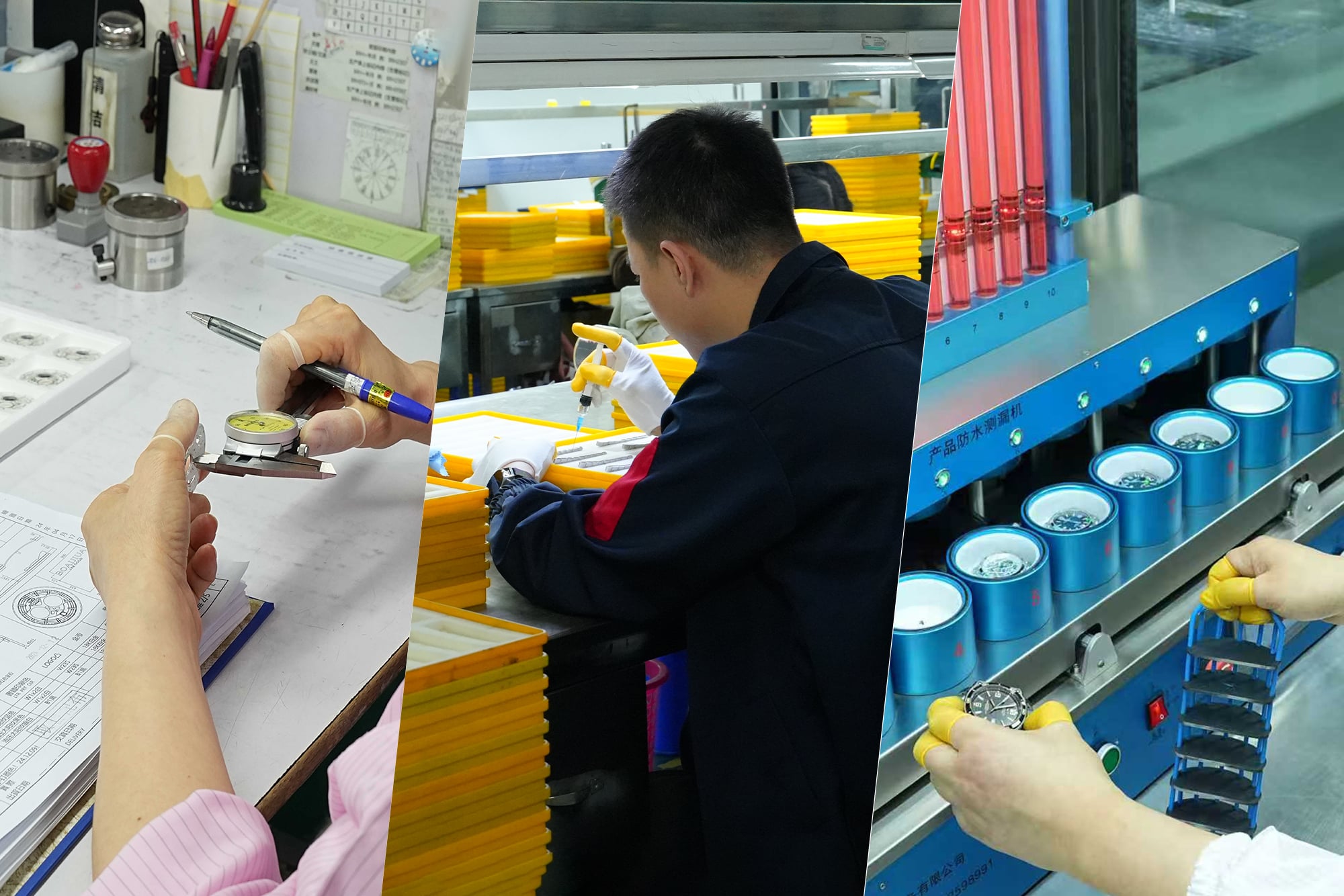
What is displacing the fragmented model is a vertically integrated manufacturing ecosystem concentrated within the Shenzhen-Dongguan corridor. Within a 50-kilometer radius, brands can access case stamping, movement assembly, dial printing, sapphire crystal lamination, laser engraving, and waterproof testing infrastructure.
This concentration enables what industry engineers refer to as a "single-roof" development cycle—where design feedback, tooling adjustments, and QC corrections occur within hours rather than weeks. Prototyping time compresses by nearly 40% compared to decentralized sourcing. The proximity does not merely reduce logistics costs; it fundamentally alters the engineering workflow by enabling real-time collaboration between the brand's design team and the factory's DFM engineers.
The transition from fragmented to integrated sourcing follows a predictable three-stage progression that brands should plan for.
Stage One — Geographic Consolidation involves contracting multiple suppliers within the same manufacturing hub. A brand may still work with separate case, dial, and bracelet factories, but all are located within the Pearl River Delta. This reduces shipping latency and simplifies on-site audit scheduling.
Stage Two — Lead Factory Coordination designates one manufacturer as the primary coordinator. This lead factory manages the sub-supplier network on the brand's behalf, providing a single point of accountability while maintaining specialized production lines across multiple facilities.
Stage Three — Full-Scope Vertical Integration consolidates all production—from case forging to final assembly and water resistance testing—within a single manufacturing partner. This is the model that delivers the shortest turnarounds and the most consistent quality outcomes, but it requires a partner with demonstrable capability across all exterior component categories.
The following comparison draws from actual brand data across three production cycles:
Performance Metric |
Fragmented Model (5+ suppliers) |
Integrated Full-Scope Model (1 partner) |
Development Lead Time (brief to delivery) |
10–14 months |
5–7 months |
First-Batch QC Rejection Rate |
15–22% |
3–6% |
Project Management Hours per Collection |
400–600 hours |
150–200 hours |
Logistics & Customs Cost (% of component cost) |
8–12% |
2–3% |
The integrated model does not necessarily reduce per-component piece cost. In some cases, single-source pricing may be marginally higher. The total cost of development, however, is consistently 30–40% lower when accounting for rejected batches, expedited shipping, rework labor, and delayed market entry.
The restructuring is not yet complete. Global brands are in the middle of a multi-year supply chain transformation that will likely conclude by 2028. Early movers—brands that consolidated their manufacturing relationships before 2024—are already realizing measurable advantages in speed-to-market and defect reduction.
Brands still operating on the fragmented model are encountering rising minimum order quantities, extended lead times, and reduced flexibility from suppliers who are themselves consolidating capacity. The market is effectively compelling the transition. For brands evaluating sourcing strategies in 2026, the decision is no longer whether to restructure, but how rapidly to execute the shift without destabilizing the existing product pipeline.
Q: Does integrated manufacturing always require relocating the brand's design team to Asia?
A: No. Modern collaboration models operate through structured design handoffs, digital file transfer, and periodic on-site visits during critical phases—prototype sign-off and production qualification. The key infrastructure is a manufacturing partner with in-house DFM engineering capable of interpreting design intent and providing structural feedback remotely.
Q: What is the minimum viable order quantity for an integrated full-scope manufacturer?
A: This varies by manufacturer, but most integrated facilities in the Shenzhen-Dongguan corridor accept projects starting at 500 units for complex case designs. Below that threshold, the tooling amortization per unit becomes economically challenging for both parties.

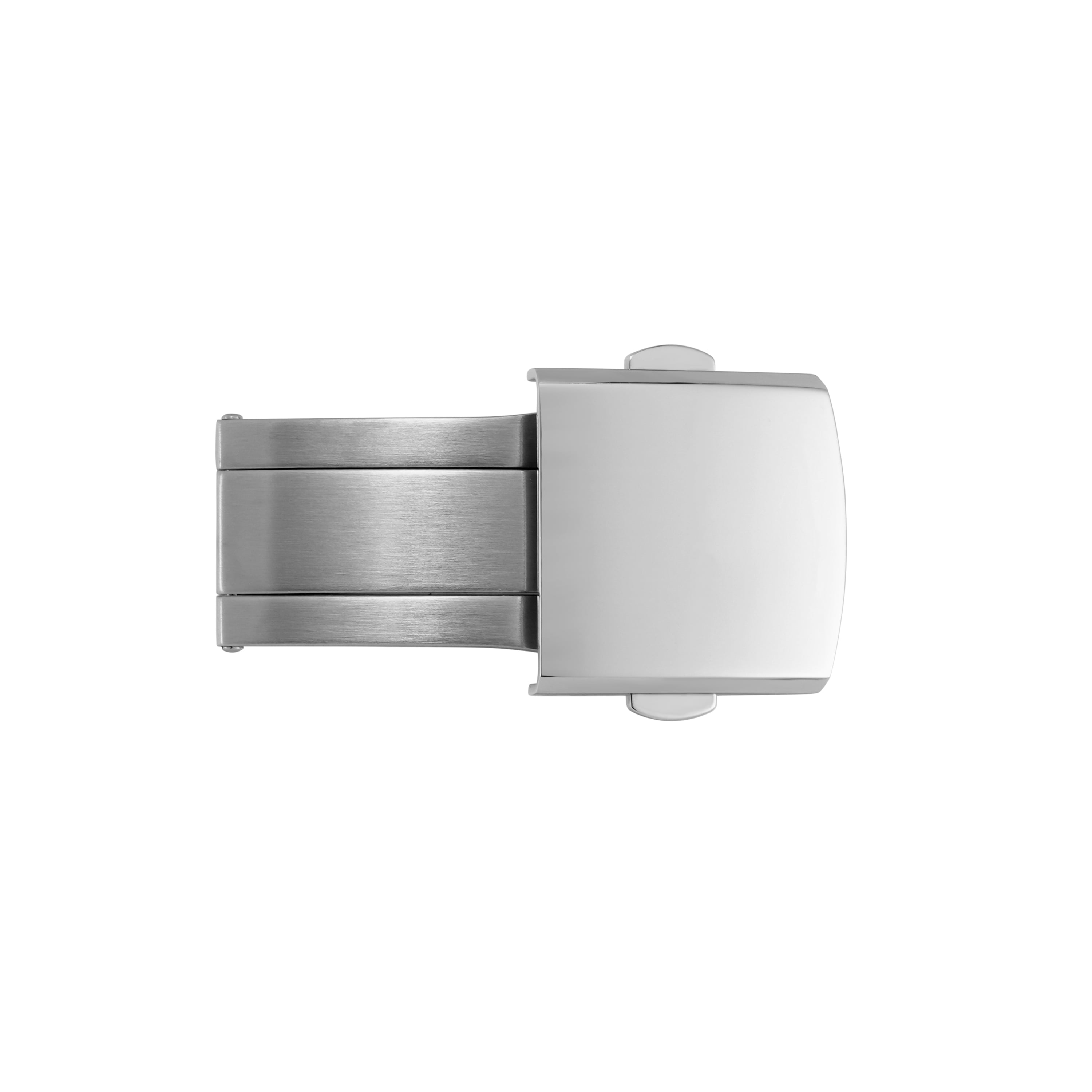
Baoruihua (Dongguan) Precision Technology Co., Ltd. is a precision watch manufacturer specializing in OEM and ODM watch components, including cases, dials, bracelets, and buckles. We provide stable production, strict quality control, and reliable supply for global watch brands. Contact us to discuss your project.
Building5, No.459 Xiecao Road, Xiegang town, Dongguan, Guangdong
Copyright © 2025 by Baoruihua (Dongguan) Precision Technology Co., Ltd. Privacy Policy
 EN
EN
 Hot News